Published Aug 19, 2026
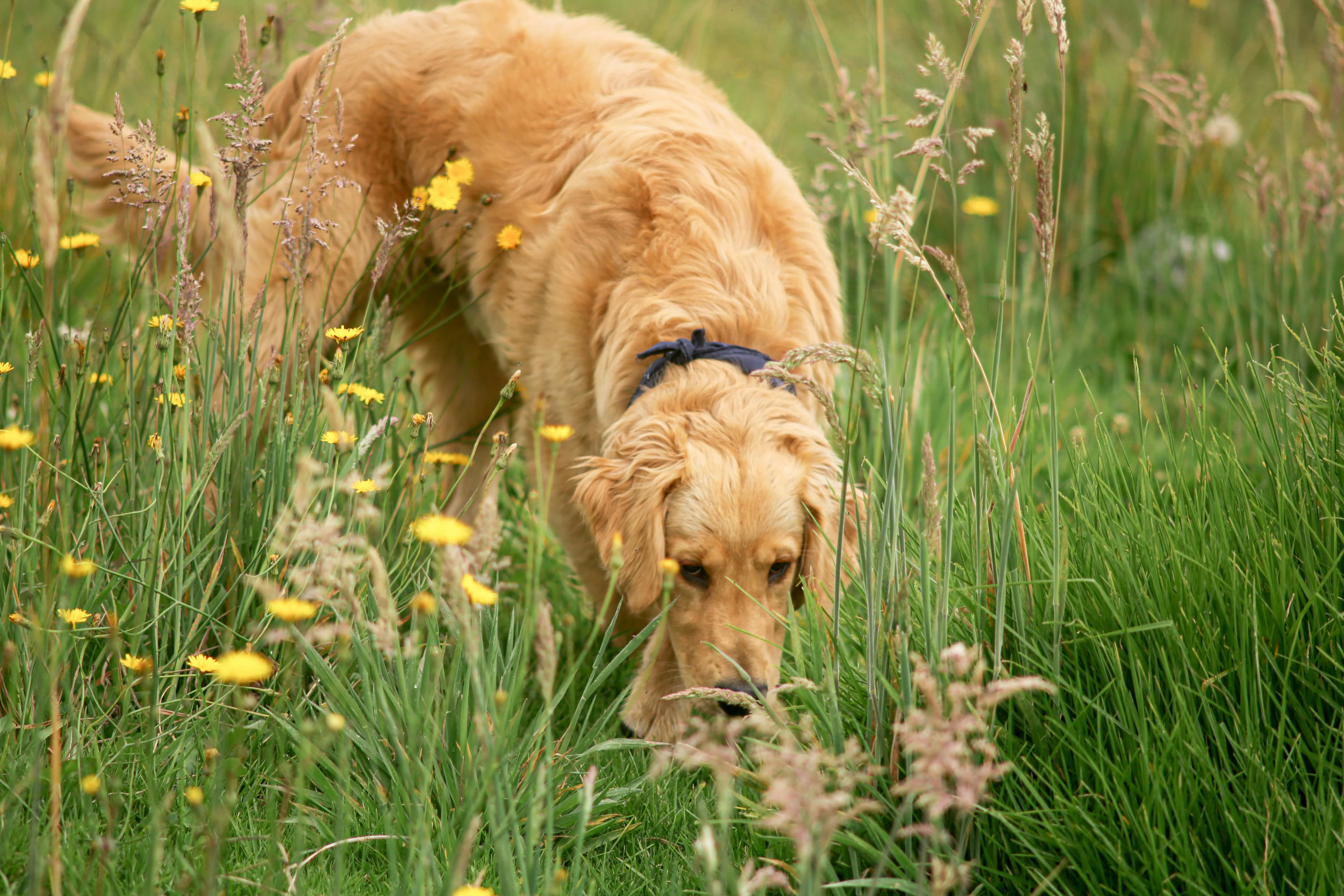
You're on a walk. Your dog stops at a patch of lawn, sniffs, and starts chewing grass like it's a salad bar. You pull the leash, mildly worried. Isn't that a sign something's wrong? Doesn't a dog eat grass to throw up?
That's the story everyone tells. It's also mostly wrong.
The "dogs eat grass because they're sick" theory has been circulating for decades, gets repeated in vet waiting rooms, and shows up in every generic pet blog. When researchers actually studied it, the numbers didn't line up. A survey of over 1,500 dog owners at UC Davis found that only 22% of dogs regularly vomited after eating grass. Fewer than 10% showed signs of illness before doing it. The overwhelming majority of grass-eating dogs are healthy, normal, and not trying to make themselves sick.
So what's actually going on? Here's what the research says, what most vets will tell you off the record, and the specific situations where grass-eating actually deserves attention.
The boring truth: most dogs just like it
The most common reason a dog eats grass is that grass is interesting. It smells like other animals. It has texture. It moves in the breeze. Chewing it feels like something to do.
Dogs are foragers by ancestry. Wolves eat grass. Coyotes eat grass. The stomachs of wild canids frequently contain plant material — not because they're all sick, but because it's a normal part of what canines do when they have downtime and something green in front of them. Domestic dogs kept the behavior. The instinct to sample the environment doesn't switch off just because there's kibble in a bowl at home.
This means the answer to "why is my dog eating grass" is often the same as "why is my dog sniffing that fire hydrant" or "why is my dog rolling in something disgusting." Because they're a dog and it's there.
The second reason: they're bored
The next biggest factor is boredom. Dogs who don't get enough mental stimulation find things to do. If a bored teenager finds their phone, a bored dog finds grass.
Look at when the grass-eating happens. A dog who chews grass halfway through a long, sniffy, engaging walk is telling you something different than a dog who bolts to the nearest lawn the second you open the door. The second dog probably needs more of everything — more exercise, more sniff time, more novelty, more actual engagement with you rather than a rushed loop around the block so you can get back to your laptop.
This is where grass-eating overlaps with attention-seeking. Some dogs learn very quickly that eating grass reliably produces a reaction from their human — a pull on the leash, a firm "leave it," attention of any kind. In a life where they get very little narrative structure, negative attention still counts as an event. If you find yourself in a battle about the same grass patch every day, part of what's keeping it alive is you responding.
The nutritional deficiency theory (mostly a myth)
You'll read that dogs eat grass because they're low on fiber, missing a nutrient, or trying to self-medicate for a stomach issue. The nutritional angle sounds scientific and gets repeated a lot, but the evidence is thin.
Studies that switched dogs to high-fiber diets didn't see grass-eating stop. Puppies eat grass just like adult dogs, and puppies are almost never nutrient-deficient because they're on carefully formulated food — if you're still getting ready for a puppy, that's one behavior to expect early rather than something to fix. Well-fed dogs on premium diets eat grass at the same rates as dogs on lower-tier food. If a specific nutrient shortage were driving the behavior, we'd see it disappear when the shortage was fixed. We don't.
That doesn't mean nutrition never plays a role — every rule has exceptions. But if your dog is on a decent complete-and-balanced diet and eats grass, changing the food probably won't stop it. The behavior is more likely about behavior than biochemistry.
The digestive discomfort theory (sometimes true)
Now the caveat. Some dogs do eat grass when they feel off. The research showed a minority — but not zero — of dogs who eat grass and then vomit. In some cases, the sequence looks intentional: dog seems restless, dog eats grass fast, dog vomits shortly after, dog seems relieved.
The picture is muddier than the folklore suggests, though. Dogs who are actually nauseous will often refuse food, hide, drool, or lick their lips repeatedly — well-recognized signs of nausea before any grass gets involved. If your dog does none of that and then chomps a mouthful of lawn, they're probably not sick. They're probably being a dog.
When it does look like self-medication, the grass often works less by being medicinal and more by physically triggering a vomit reflex. Long grass, in particular, can tickle the throat and prompt regurgitation. Some dogs figure this out and use it. It's not stupid, but it's not proof of some hidden wisdom either.
When grass-eating is actually a problem
Most grass-eating is harmless. There are specific situations, though, where it needs attention.
A sudden change in behavior. A dog who's never eaten grass and suddenly starts, especially if it's frantic or repetitive, is worth watching. Combined with other signs — reduced appetite, restlessness, a change in stool — it can point to a GI issue. Not always. But paired with other symptoms, don't try to read the pattern yourself — consult your vet.
Vomiting more than once or twice. Occasional post-grass vomiting is common. If it becomes a pattern — most days, multiple times a week — the grass isn't the cause. The grass is a symptom. Something else is going on, and consulting your vet is more useful than trying to keep them off the lawn.
Eating specific plants that aren't grass. This is where the real risk lives. Lawns are usually fine. Ornamental gardens and roadside vegetation often aren't. Sago palm, oleander, lily of the valley, azalea, foxglove, autumn crocus — dozens of common landscaping plants are toxic to dogs, sometimes fatally. If your dog is a plant-eater, know what's in your yard and where you walk. The ASPCA maintains a searchable database of toxic plants worth bookmarking.
Chemicals on lawns. Municipal parks, apartment complex lawns, and neighbors' yards are often treated with herbicides, fungicides, and insecticides. Most are labeled safe for pets once dry, but "safe" varies by chemical, dose, and dog. If your dog eats grass on treated areas repeatedly, they're getting exposure that adds up. Redirect to grass you know is untreated when you can.
Eating grass and then not eating food. A dog who fills up on grass to the point of skipping meals is either bored to a concerning degree or telling you something feels wrong. Either way, worth investigating. The warning signs to watch for in a new pet's first weeks apply here — the shape of an appetite change often matters more than the change itself.
Compulsive-looking eating. There's normal chewing, and there's something that looks off — glazed eyes, ignoring your voice completely, unable to stop even when you interrupt, repeated to the point that gums are getting scraped. That's not appetite. That's a behavior that has gone somewhere else. It's rare, but pica (persistent eating of non-food items) is a real condition, and grass is often on the list. Worth a vet consult.
What not to do
Panic every time. Grass-eating is not usually a medical emergency and not usually a sign of disease. Constant intervention creates the attention loop mentioned above and often makes the behavior more entrenched, not less.
Give a "cure" from the internet. There is no supplement, food change, herb, or trick that reliably stops grass-eating in a healthy dog who just enjoys it. Anything that claims to is either selling you something or overpromising.
Assume it means kibble is bad. Dog food discourse online has trained people to blame kibble for everything. Grass-eating happens on raw diets, home-cooked diets, prescription diets, and premium kibble at similar rates. If you want to change your dog's food for other reasons, fine, but don't do it to stop grass-eating.
Pull hard on the leash. Corrections don't teach the dog "grass is bad." They teach the dog "when I try to sniff or chew things, my throat gets yanked." Long-term, that damages the walk itself. Redirect calmly to something more interesting when you can. Let it go when it's a small mouthful and the dog is otherwise healthy.
The short version
If your dog is otherwise healthy — eating normally, drinking normally, energetic, no vomiting patterns, no weight loss — occasional grass-eating is fine. It's a dog thing. The centuries of folklore about it are mostly wrong, and the science backs that up.
The situations that actually deserve a vet call are the ones that involve pattern change, additional symptoms, potentially toxic plants, or compulsion. A dog eating a few blades on a walk isn't one of them.
Watch what surrounds the behavior more than the behavior itself. That's true for grass. It's true for most of what dogs do.
For dogs still adjusting to a new home, grass-eating can look more concerning than it is because everything is new. If you're in the first week with a rescue dog, a certain amount of odd behavior comes with the territory and doesn't need intervention beyond patience.
Tags
- dog health
- dog ownership
- pet care
- puppies
- puppy training
- responsible pet ownership
- when to call the vet